Theory
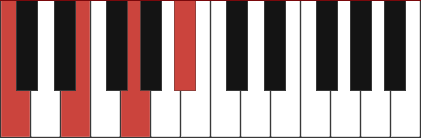
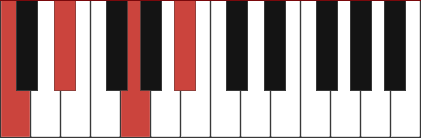
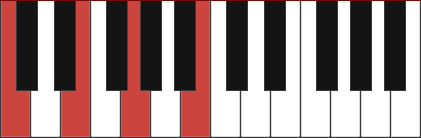
The seventh chords have in common that the seventh note of a scale is added to a triad (a three-note chord), making it a four-note chord (also called a tetrachord).
Dominant 7th
The name "dominant" refers to the fifth degree of the diatonic scale. It is called dominant because it is most weighty besides the tonic (the root of the scale) and it's neither major nor minor. The most common dominant chord is a dominant seventh in which a minor seventh is added to a triad major. A less common alternative chord name for C7 is Cdom7 (dom stands for dominant). A slight dissonance could be heard in 7th chords because the seventh note often creates tension that seeks resolution. Note that the fifth sometimes are omitted, especially when these chords are inverted.
Major 7th
Major 7th is constructed by adding the seventh tone in the scale to a major triad.
Minor 7th
Minor 7th is constructed by adding a minor seventh tone in the scale to a minor triad. Similar to the 7th chord, a slight dissonance could be heard in minor 7th chords because one of the notes, the seventh, is not included in the same key as the root note.
Make use of
How and when to use seventh chords? Seventh chords are common in many music styles, but especially in blues (major 7th not included) and jazz.
Chord sequences that show how 7th chords can be utilized:
1. C - F - G7 - C
2. C7 - F7 - C7 - G7 - F7 - C7
3. C7 - F7 - C7 - Dm7 - G7 - F7 - C7
4. C7 - F7 - C7 - A7 - Dm7 - G7 - C7
5. Dm7 - G7 - Cmaj7
The first progression is an example with a dominant seventh as V7 chord that resolves back to the I chord. Progressions 2 and 3 are typical in blues and the last two are typical in jazz. See How to combine piano chords for more examples and explanations.
7th chords are sometimes played as part-over-root chords. This is done by playing the upper structure with the right hand and the bass with the left hand. For example Cmaj7: C plus E – G – B one octave up.
Chord structures that show voicings with different bass voices based on C7:
- C7/D can be played D1 (LH) C2 – E2 – G2 – Bb2 (RH), and could also be named C9/D.
- C7/E can be played E1 (LH) C2 – E2 – G2 – Bb2 (RH), and could also be seen as the second inversion of C7.
- C7/F can be played F1 (LH) C2 – Eb2 – G2 – Bb2 (RH), and could also be named Fmaj9sus4.
- C7/G can be played G1 (LH) C2 – Eb2 – G2 – Bb2 (RH), and could also be seen as the third inversion of C7.
- C7/A can be played A1 (LH) C2 – Eb2 – G2 – Bb2 (RH), and could also be named C13/A.
- C7/Bb can be played Bb1 (LH) C2 – Eb2 – G2 – Bb2 (RH), and could also be seen as the fourth inversion of C7.
Chord structures that show voicings with different bass voices based on Cmaj7:
- Cmaj7/D can be played D1 (LH) C2 – E2 – G2 – B2 (RH), and could also be named C9/D or D9sus.
- Cmaj7/E can be played E1 (LH) C2 – E2 – G2 – B2 (RH), and could also be seen as the second inversion of C major 7th.
- Cmaj7/F can be played F1 (LH) C2 – E2 – G2 – B2 (RH), and could also be named Cmaj11/F.
- Cmaj7/G can be played G1 (LH) C2 – E2 – G2 – B2 (RH), and could also be seen as the third inversion of C major 7th.
- Cmaj7/A can be played A1 (LH) C2 – E2 – G2 – B2 (RH), and could also be named Am9.
- Cmaj7/B can be played B1 (LH) C2 – E2 – G2 – B2 (RH), and could also be seen as the fourth inversion of C major 7th.
Chord structures that show voicings with different bass voices based on Cm7:
- Cm7/D can be played D1 (LH) C2 – Eb2 – G2 – Bb2 (RH), and could also be named Cm9/D.
- Cm7/Eb can be played Eb1 (LH) C2 – Eb2 – G2 – Bb2 (RH), and could also be seen as Eb6 or the second inversion of C minor 7th.
- Cm7/F can be played F1 (LH) C2 – Eb2 – G2 – Bb2 (RH), and could also be named F9sus4.
- Cm7/G can be played G1 (LH) C2 – Eb2 – G2 – Bb2 (RH), and could also be seen as the third inversion of C minor 7th.
- Cm7/Ab can be played Ab1 (LH) C2 – Eb2 – G2 – Bb2 (RH), and could also be named Abmaj9.
- Cm7/Bb can be played Bb1 (LH) C2 – Eb2 – G2 – Bb2 (RH), and could also be seen as the fourth inversion of C minor 7th.
The numbers are indicating relative octaves whereas LH and RH stands for left hand and right hand.
Minor 7b5
Minor 7th flat 5 is built by taking a minor seventh chord and lowering the fifth (indicated by b5 in the chord name). This chord group is also known as half-diminished. It is commonly used in jazz and can function as the ii chord in ii-V-I progressions.
Additional seventh chords
Here are the other three groups of seventh chords, with examples in the note of C:
Cdim7: C – Eb – Gb – A
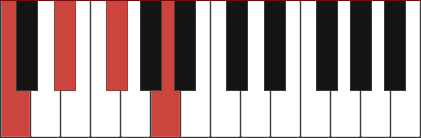
Caug7: C – E – G# – A#
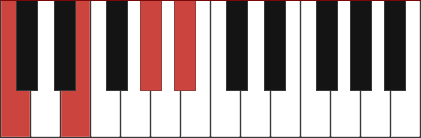
CmM7: C – Eb – G – B
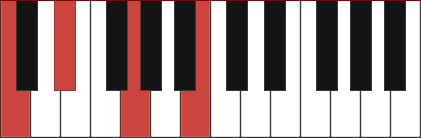
Alternate seventh chords
There are other seventh chords such as 7b5 and 7#9. For more variations of seventh chords, see Altered chords.
For more in-depth about music theory, see Chord Theory for Piano eBook.
Chord categories
Major chords Minor chords Seventh chords Extended chords Sus chords Dim chords Aug Chords Add Chords Altered Chords